

Ranchor Prime, a disciple of ISKCON founder A. C. Bhaktivedanta Swami Prabhupada, shared a compelling journey of devotion, music, song, and creative expression:
“In January 2005, my old friend Ian Roberts told me that the celebrated British composer Sir John Tavener was working on a major composition based on the life of Krishna and urgently needed help with the libretto. His Sanskrit adviser from Manchester had recently died, and Ian hoped to introduce me to Tavener through our mutual friend, the Orthodox monk Brother Aiden.
Two days later, Tavener phoned me in London and invited me to stay overnight at his home in Dorset. He sounded utterly absorbed in what he called his Krishna project. The next morning, a seven-page handwritten letter arrived outlining his “rough formal scheme” for a work titled Essence of Krishna.
The proposed opera was immense in scope: a mystical retelling of Krishna’s life, from his divine birth and childhood pastimes to the Bhagavad-gita and his final departure from the world. Tavener envisioned a carefully mirrored structure moving through childhood, adolescence, adulthood and transcendence, framed by cosmic lamentation and redemption.
“I want a very rigid mathematical structure,” he wrote, “in order to allow the imagination to fly.”
He wanted the work to possess the childlike simplicity of The Magic Flute while revealing “an eternal metaphysical truth.” Though inspired by Indian spirituality, he was determined the piece should not feel “pseudo-Indian,” even while drawing upon Vedic rhythms and sacred chants.
A second letter soon followed asking me to draft lines for the prologue and epilogue and experiment with different syllabic patterns. His enthusiasm was infectious. Then came a postcard written hurriedly on a train:
“How to create something truly magical – Snow White – Midsummer Night’s Dream – Hindu Temple Drama – The Magic Flute!!”
In early February, I travelled to Gillingham station, where Tavener’s wife, Maryanna, collected me. Their home in Child Okeford, beneath Hambledon Hill, was a large former vicarage surrounded by open countryside.
Tavener met me at the door and immediately led me to a piano. Without pause, he began playing scenes from his unfinished work while narrating them aloud.
Gentle lyrical passages represented Yasoda and the infant Krishna. Celestial melodies followed as Krishna sat upon his mother’s lap. Suddenly the music darkened.
“Now comes the witch Putana,” he said, “with poison smeared upon her breast.”
The piano surged into violent intensity before dissolving into luminous calm.
“Krishna takes her soul to paradise.”
It was extraordinary to witness. The music seemed less composed than revealed.
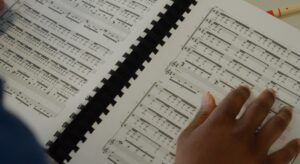
His study looked like a furnace of creativity. Huge sheets of pencilled manuscript covered every surface, with another piano standing in the corner. Almost immediately he turned to what he regarded as the emotional and spiritual centre of the opera: the love duet between Radha and Krishna.
“I must have the right words,” he said. “Can you give me a mantra?”
I hesitated before replying.
“The Hare Krishna mantra has everything already. It is itself a love song between Radha and Krishna.”
“Tell me more,” he urged.
I explained that the mantra could be understood as a divine exchange of love: Krishna calling Radha through the name “Hare,” while Radha responds with Krishna’s names, “Krishna” and “Rama.”
Tavener immediately grasped the idea.
“Yes,” he said. “I like that.”
For the rest of the afternoon we discussed sacred names, cries for mercy and the deeper symbolism of Krishna’s pastimes. He moved rapidly between theology, music and dramatic structure, hardly pausing for breath. At times he left me alone in the study to draft fragments of text and possible chants for him to consider.
Later, over tea and sandwiches in the kitchen, the conversation became more personal. Tavener spoke about the agony and ecstasy of composing.
“When I am in the middle of composing,” he said, “I can think of nothing else. I hardly eat or sleep. But once the work is finished, and I have nothing more to create, I feel suicidal.”
The intensity of his words startled me. He seemed utterly consumed by spiritual longing. He spoke constantly of God, prayer and transcendence, and confessed that he found the modern world increasingly difficult to inhabit. Sacred music was not merely his profession; it was his means of survival.
He spoke too of Wolfgang Amadeus Mozart and the lifelong influence of The Magic Flute. As a child, his grandmother had taken him repeatedly to see the opera, which he regarded as perhaps the greatest work of Western art. Ever since, he had longed to create something with the same innocence, wonder and metaphysical depth.
For Tavener, the Krishna story finally offered that possibility.
As evening fell, we walked beneath Hambledon Hill while his dog Leyla bounded through the fields ahead of us. We spoke about spiritual life, devotion and the search for God until darkness drove us back to the warmth of the house and a long conversation beside the fire.
The next morning, after breakfast, Tavener drove me to the station. He seemed thoughtful and distant as we said goodbye.
Then came silence.
For months I heard nothing further and wondered whether the project had collapsed. But nine months later, while returning from Glastonbury, I made an unexpected detour through storm and rain to Child Okeford to discover what had become of the work.
Tavener greeted me warmly and led me straight back into his study. There, spread across tables in towering piles, was the completed score: Krishna Lila: A Mystical Pantomime.
“You gave me exactly what I needed,” he said.
He showed me the central love duet. Page after page contained the Hare Krishna mantra woven through the music exactly as we had discussed during my first visit. I was astonished. What had begun as a simple conversation about sacred names had become the heart of a major musical work.
Tavener also told me that the legendary theatre director Peter Brook had expressed interest in collaborating on the production.
Years later, I read that the central duet had been previewed at the Manchester International Festival. Afterwards, Tavener told reporters:
“This love duet is the most ecstatic piece of music I have ever written.”
Today, that vision continues to resonate. In honour of the late Tavener’s enduring legacy, Grange Park Opera will present the world premiere of Love, Devotion and the Cosmos: Krishna’s Eternal Dance in June and July 2026 — a fitting tribute to a composer who sought, through music, to illuminate the eternal beyond.
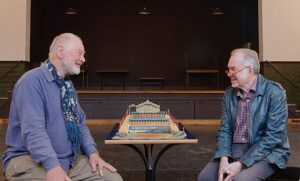
Ranchor Prime prabhu with Sir David Pountney, a renowned British opera and theatre director and Artistic Director of Grange Park Opera
Learn more about the production, the venue, and ticket booking*:
https://grangeparkopera.co.uk/whats-on/krishna/
*NB: The Grange Park Opera House, (located in West Horsley Place, Leatherhead in Surrey KT24 6AN) is known for its elegance. All attendees with tickets are required to dress spectacularly: Think “classy Indian wedding” – as is opera etiquette.